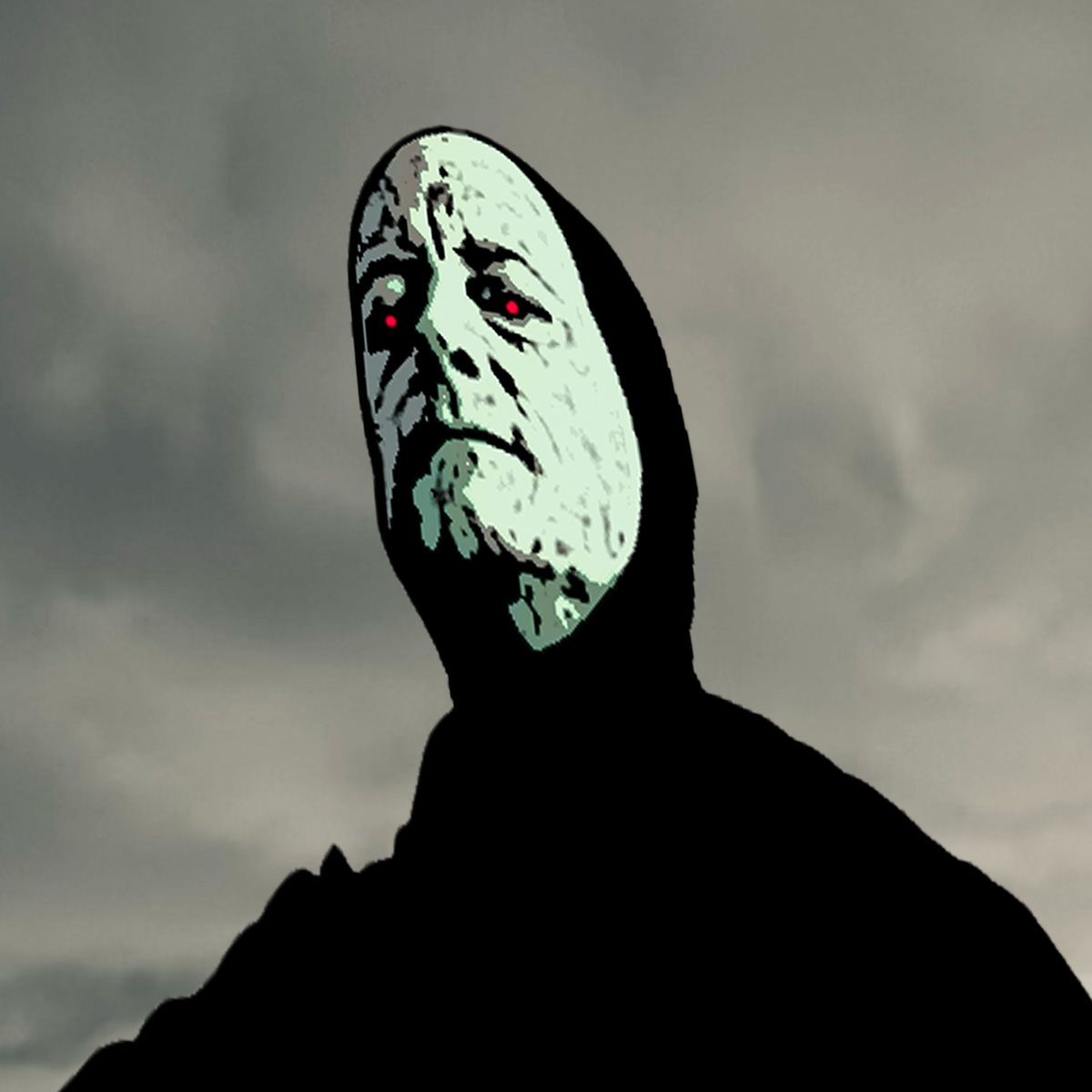
Directed by Ken Russell (1974) … an anemic Gustav Mahler (Robert Powell) is besieged by fever dreams and memories of his life during a train ride to Vienna.
The opening fever dream sets flames Mahler’s lakeside composition hut. Along the shoreline, a nude woman webbed in a cocoon wriggles up to the decapitated head of a statue, one assumes is the weathered marble head of Mahler.
On the train to Vienna, Mahler tells his wife, Alma (Georgina Hale), about the dream. He tells her she was a living thing, struggling to be born, a chrysalis. This is an apt metaphor for Alma’s own ambitions, for she begrudgingly cares for the great composer, while wanting to become one herself.
No one is free of torment in this film. Mahler’s Jewish upbringing is a pressure cooker for him to become a wunderkind pianist, when really what he wants is to compose. His piano teacher ridicules his ambition to compose. An abuse Mahler will pass on to his wife decades later, telling her in front of a classical singer one of her compositions is amateur.
Mahler’s not a complete monster. There’s a tender moment between him and his two daughters who engage him in a Q&A about God while perusing a book of illustrations from Gustave Dore’s Paradise Lost, richly detailed illustrations of angels and demons that must’ve influenced Russell into divining his own crazed imagery and sequences.
Where Mahler’s passion is for composing, Ken Russell’s passion is for conjuring hellish fever dreams, tormenting Mahler’s Jewish psyche: a couple of erotic whoppers with a whip-cracking dose of S&M Nazi fetishism, anachronistic of Mahler’s time; Russell makes evil sexy as a death camp cabaret; there’s Mahler being cremated by his wife after she performs a strip tease on top of his coffin; there’s Mahler’s conversion to Catholicism, a baptism by fire beneath a gigantic cross and iron sword under the goose-stepping boot heels of a Nazi dominatrix.
Russell’s cinematic sorcery must’ve influenced the advent of music videos (MTV debuted in 1981) … but Russell must’ve been influenced by Kenneth Anger’s Scorpio Rising (1963) and possibly Alexandro Jadorowsky’s Holy Mountain (1973). Russell also pays tribute to Luchino Visconti’s Death in Venice (1971) by having Mahler imagine the composer and the boy from Visconti’s film on a train platform. Mahler’s hut inferno must’ve inspired David Lynch to set that beachside hut ablaze in Lost Highway (1997).
Yet, filmmakers like Lynch and Jadorowsky create hallucinatory sequences that transcend logic and stir the subconscious. You won’t find that here, except possibly in the opening fever dream before its explained by Mahler.
Russell’s film tends to lean towards being a campy romp with boils of anxiety, sometimes leaning in shallow territory, such as the portrayal of Mahler’s Jewish family veering into stereotypes, obsession over money, a Jewish grandfather talking with soup in his mouth.
What’s at the core of Mahler’s obsession is to compose all of nature as an expression of the very nature denied him as a boy. There’s a scene where Mahler as a boy almost drowns attempting to swim in a lake. It’s obvious there’s an entire childhood of play and exploration he’s having to forfeit to become a prodigy. A Peter Pan like man with an accordion teaches him how to swim and reads some of Mahler’s music, telling him it’s good, but that it’s missing the very essence of nature. This leaves Mahler wanting to explore all of nature and wanting to put all of nature into his music. For many geniuses, it’s often about what they could not have as a child.
There’s a scene between Mahler and a fellow composer gone mad that echoes Peter O’Toole’s imperial insanity in The Ruling Class (1972). These two composers meet in what seems like an immaculate mausoleum with an incredible hillside, stairway fountain. (Where is this place? I wanna to go there.)
This mad composer wipes his ass with his latest composition. Mahler’s brother, also a composer, commits suicide. Alma buries her composition in the woods. It’s a cautionary tale, if greatness can’t be achieved as a composer, there’s the sanitarium, or the pistol, or marrying a composer to become their caretaker.
Mahler claims his final composition is not about death, but rather a farewell to love. It’s a slow train ride to Vienna with the anemic and crabby Mahler, a ride loaded with burning memories and flames of agony.
 Demented Flicks